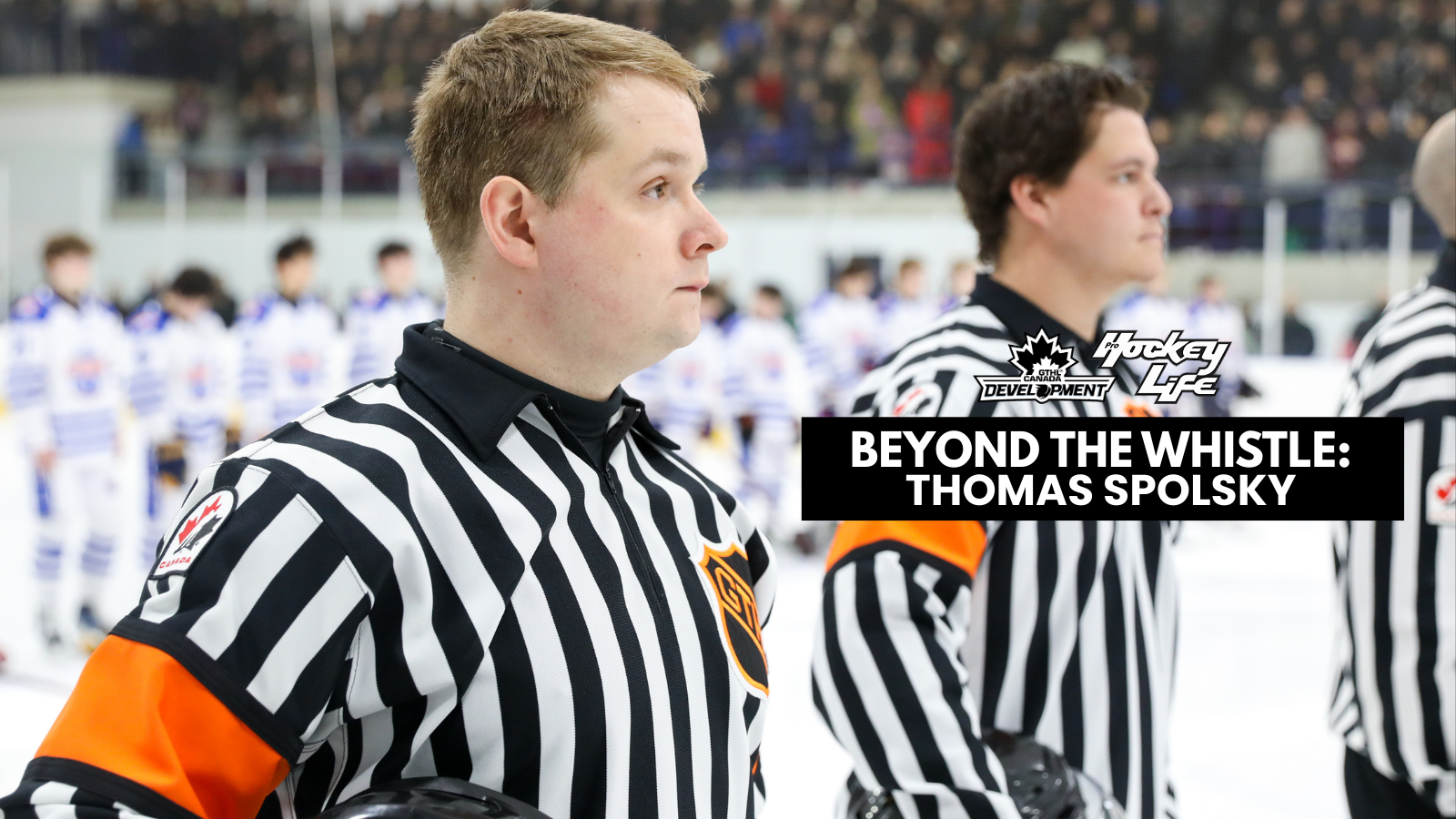
These days, when Thomas Spolsky steps onto the ice, there’s a moment of realization that hits before the puck drops.
“I’ve been having a few ‘oh, [wow]’ moments where I’m going out now and I’m the senior official on the ice,” he laughed. “I’m only 33, but I am the veteran by a number of years. It’s funny how the tables have turned… now I’m the one people look up to.”
For Spolsky, a long-time Greater Toronto Hockey League official and former GTHL player, that moment has been years in the making. This season will be his 10th in stripes in the GTHL and his 17th season officiating overall — more than half his life spent in rinks.

And it all started the way so many hockey stories do: learn-to-skate, house league, and parents who just wanted their child to love the game.
“Mom and dad, they put me in learn to skate for a couple of years. They wanted me to be able to skate before they put me on a team,” Spolsky said. “I started playing house league hockey and from there I ended up playing [competitively] for 10 years.”
He suited up for George Bell House League before moving into competitive hockey.
By his mid-teens, the question became what was next. The answer arrived in the form of a surprise announcement from his dad.
In Grade 11, Spolsky learned his dad had signed him up for the GTHL’s Referee Summer Camp, with very little discussion beforehand.
“There wasn’t a lot of talking about it, but there was that expectation that when you hit 16, you’re going to go get a job. That’s just the way it was,” he said. “You played competitive sports, you’re going to go to a school, you’re not sitting around.”
With hockey and baseball already in his life, officiating felt like a natural next step.
“I played hockey my whole life, I played baseball growing up. I started umpiring baseball the year before as well, so it was just a natural progression,” he said. “I owe my mom and my dad a lot for putting me in that course. It definitely paid off.”
He went through one of the original GTHL referee development programs — a week-long course taught by instructors he now shares the ice with. After a few years of house league refereeing, he left for university in Kingston and brought the stripes with him.
“I refereed my way through university. I enjoyed it and I needed to pay for school, so that’s pretty straightforward,” he said.
After finishing school, Spolsky returned to Toronto — and to officiating in the GTHL. But, what keeps someone on the ice for that long?
“I enjoy the challenge of being out on the ice, especially when I’m a referee,” Spolsky said. “Having played the game, having watched the game, it’s really easy to criticize officials. But when you’re out there, you want to strive for your best. You want to call a perfect game. You want to be in position, you want to work hard.”
Equally important is the community around the game.
“I also like the camaraderie with everyone out there,” he said. “Those people you spend a half hour with before the game, after the game – they become a second family to you. Just that camaraderie, that social aspect is a big reason why I stay involved in it.”
That year-round rhythm extends beyond hockey.
“I umpired for a number of years. I coached youth baseball for about six years. I got back into umpiring again and I still play men’s hardball,” he said. “Summer, winter, summer, winter. No break.”
Even with a full calendar, the best moments often arrive in his inbox.
“I don’t know if it’s one highlight, but I think if you get an e-mail, when you get asked or invited to skate one of the big end-of-year tournaments,” he said.
Whether it’s an Ontario Hockey Federation (OHF) championship, Ontario Minor Hockey Association (OMHA) championships, or the OHL Cup, the recognition means a lot.
“That recognition from the referee supervisors and from the league that recognize the effort you put in and obviously the job you’re doing… it feels good when you get that e-mail at the end of the year,” he said.
Two assignments stand out: back-to-back invitations to the GTHL Under-16 AAA Top Prospects Game.
“I was invited to do the Top Prospects Game once as a linesperson and once as an official,” Spolsky said. “Being able to do that back-to-back, that’s one of the highest recognitions I think. I worked a number of years to get there and it felt good.”
Off the ice, Spolsky works as a professional urban planner, a role that surprisingly overlaps with officiating.
“We look at how we grow as a community, how we provide housing for people, how we move throughout a city, how we provide green space and sustainability,” he said. “And there’s differing opinions, right? Not everyone thinks that we achieve the end results the same way.”
The skill set transfers neatly to the rink.
“Whether we’re on the ice or in the stands or as a coach, we see things differently,” he said. “Being able to have that conversation with someone where you may not agree on things, but at least you can provide a clear rationale – ‘this is how I view it, this is how I saw it, this is how the rules are implemented.’”
“We may not always agree with each other, but at least we can try to be respectful about it and reach an outcome that is based in fact and rule,” he added. “You may not agree with me but if I know I’ve implemented the rule properly, professionally or on the ice, I can walk away from that game feeling confident with what we’ve done.”
The teenager who once felt “completely unprepared” in his first game is now the one teaching others.
“I also am an instructor with the GTHL,” Spolsky said. “I’ve been doing that since the pandemic, about four years now. I’m the one at the front teaching the classes to new referees, seasoned referees, doing upgrade clinics.”
He remembers starting out without the technology today’s officials have.
“When I started, there was not that , it was all theoretical and spoken word and dry erase markers,” he said. “Going out on that ice and actually having to figure out your positioning, being out there, feeling a little unprepared — that’s what I remember the most.”
Now, he leans on video as a key teaching tool: “It’s a blessing and a curse because you don’t get replay, everyone else does, but at least it helps – we get a lot of footage to help you train.”
Spolsky’s pitch to potential new officials is simple.
“It is hands down the best part time job you could ever have,” he said. “If you enjoy hockey, you’re being paid to go on the ice and still be involved in the game.”
But he’s honest about the learning curve.
“You’re not going to know everything the first time you step out on the ice,” he said. “You need to think like a referee, not like a player or a fan.”
Instead, the focus is on “player safety and fairness,” and being open-minded as the game evolves. “Have an open mind to being a better official, and it will take time,” he said.
And for coaches, players, parents, and spectators — Spolsky’s message remains simple, too.
“We’re not there to determine a winner,” he said. “We all love the game of hockey. We want to implement the rule book as safely and fairly as possible.”
“Just because we’re not on the same page doesn’t mean we’re out to get you or hurt your team,” he added. “If we have mutual respect for each other, I think we can learn a lot from each other… Mutual respect goes a long way for everyone having a better outcome at the rink.”