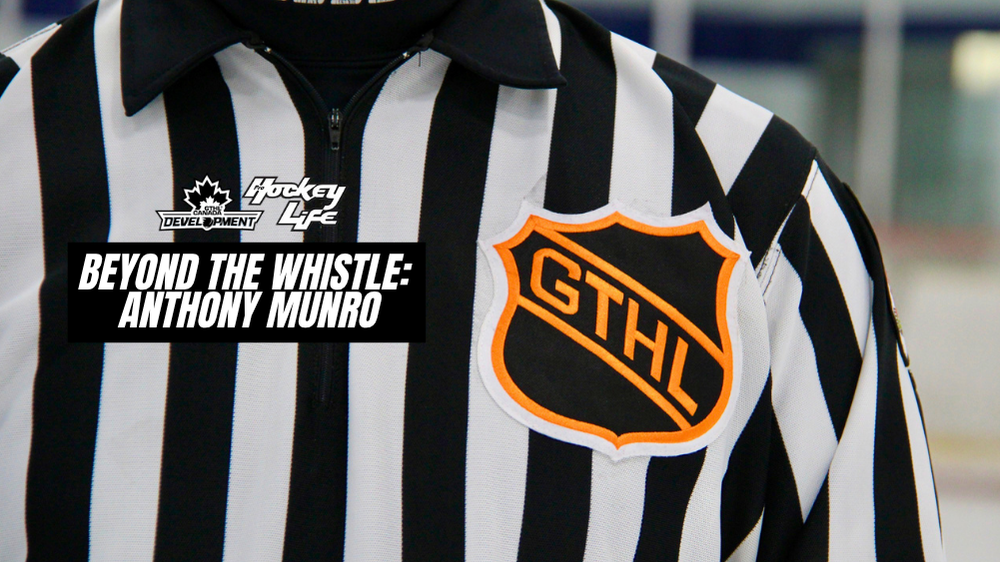
Anthony Munro never set out to become one of the longest tenured officials in Greater Toronto Hockey League history.
At 19 years old, Munro was simply a university student looking for a little extra income, some exercise, and a way to stay connected to a game he loved. More than three decades later, he is preparing for his 32nd season as a GTHL official, a recipient of the Gus Gordon Officiating Award, a mentor to younger referees, and a familiar face in rinks across the Greater Toronto Area.
His journey into hockey began long before he ever put on a referee’s armband.
Born in Birmingham, England, Munro moved to Canada with his family when he was seven years old after his father accepted a job opportunity in Toronto. Hockey was completely foreign to him. In England, he had never really skated and knew little about the game. Then came his first days at school.
“Everybody was hockey, hockey, hockey,” Munro recalled.
Hockey fever hit him strong after everyone at school was playing and talking about it. He went home and told his parents he wanted to get on the ice and he quickly learned to skate. As he started in house league at Pleasant View, then later playing competitive hockey with the Agincourt Lions in Scarborough, the sport had become a major part of his life.
The game’s pull was so strong that it even influenced his family. His father arrived in Canada as a soccer enthusiast but grew into a devoted Hockey Night in Canada viewer, spending Saturday nights cheering on the Toronto Maple Leafs.
Munro eventually realized that a professional hockey career was not in the cards. By his mid-teens, other priorities began to take over. Still, he wasn’t ready to leave the rink behind. Two years after finishing his playing career, he took an officiating clinic through the North York Hockey League and gave refereeing a try.
“I didn’t want to coach,” he said. “So I thought I’d give this refereeing thing a try.”
What started as a part-time job quickly became something much bigger.
After officiating in North York and later in Barrie while establishing his professional career, Munro returned to Toronto and joined the Metropolitan Toronto Hockey League (now the GTHL). He wanted to work in the highest level of minor hockey possible.
“You knew that was the premier league for kids’ hockey,” he said. “You don’t want to take a step back.”
Over the next three decades, Munro balanced officiating with a mathematics degree from York University, a career in information technology at Bell and IBM. Through it all, officiating always remained a part of his life.
The reason he kept coming back changed over time.
“The money became a bonus,” Munro said. “It became about the people.”
He speaks fondly about the friendships built through officiating, the longtime colleagues who still text each other before games, and the camaraderie that develops after sharing the highs and lows of hundreds of nights at the rink. For Munro, those relationships have become as important as the hockey itself.
His longevity has also given him a front-row seat to hockey history.
Munro estimates that he has been on the ice with nearly every elite player to come through the GTHL and MTHL since the early 1990s. Among them was Connor McDavid. Munro remembers full arenas packed with scouts and spectators when Connor McDavid was still a teenager, long before he became an NHL superstar.
“At the time it was cool,” Munro said. “But it’s even cooler when you look back and realize you were there.”
Yet his proudest accomplishment may be the reputation he built rather than the names he encountered.
In 2025, Munro received the Gus Gordon Officiating Award, an annual honour that recognizes an official who displays a balance between positive attitude, dedication, competence, and improvement within the GTHL. He admits the recognition surprised him. Rather than pursuing the spotlight, he built his career on consistency, reliability, and professionalism.
Munro believes the best officiating performance is often the one nobody notices. If players, coaches, and parents leave the rink remembering the game rather than the referee, he considers that a success.
Today, Munro has become the veteran official that younger referees seek out for guidance. Having served as a supervisor of officials and mentor to developing referees, he regularly helps younger staff navigate difficult situations and rule interpretations.
For former players who may be considering officiating in the GTHL, Munro believes the experience offers far more than money.
From ice level, officials learn how the game truly flows, how to make decisions under pressure, and how to communicate confidently with players, coaches, and parents. Those skills often carry into careers and everyday life. Munro credits officiating with helping him become a stronger communicator throughout his professional career.
His advice is simple: if you love hockey, give it a try.
The friendships, life experiences, and personal growth are impossible to predict when you first step onto the ice as an official. Looking back on more than 30 years of refereeing, Munro says the lessons learned, the people met, and the memories made have been worth every game.
What began as a way to earn some extra money ended up becoming a lifelong connection to the sport — and a career dedicated to ensuring the next generation gets to enjoy the game he fell in love with as a seven-year-old newcomer to Canada.