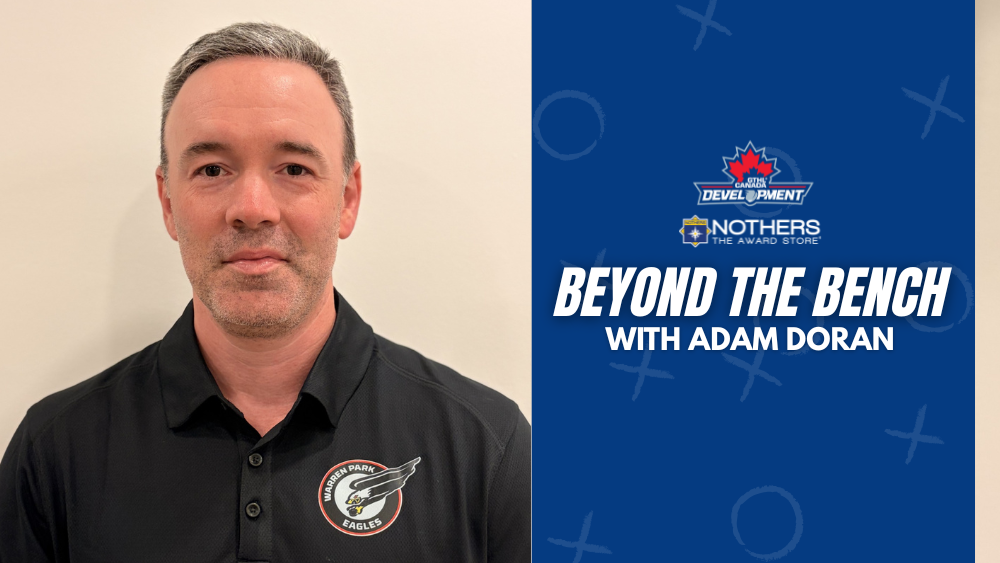
For Adam Doran, coaching hockey is about much more than systems, line combinations, or the final score. It’s about helping young players grow into confident teammates, resilient individuals, and future leaders.
Now entering his third year as a coach with the Warren Park Eagles, Doran has quickly established himself as a passionate mentor whose focus extends far beyond the rink. Yet his coaching journey began long before he stepped behind the bench.
“It’s always been in me to be involved with coaching,” Doran said. “Growing up, I had this idea that maybe one day I’d coach in the NCAA. I have no idea where that came from, but it was in the back of my mind for some reason.”

As a teenager, Doran had opportunities to observe Ontario Hockey League and Team Canada preparation camps, gaining an early appreciation for player development and leadership. Years later, when his own children became involved in sports, that long-standing interest evolved into action.
Today, he views coaching as an opportunity to invest in his community.
“Coaching is really about giving back,” he said. “I think we’re really designed to be givers. We take a lot wherever we go. I just think it’s so important to give back and put your energy into your community.”
Doran coaches his son’s hockey teams and has also become involved in youth baseball, helping support both his son’s and daughter’s development. Through those experiences, he has come to appreciate just how much impact coaches can have, not only on athletes but on entire families.
Last season, Doran coached a Under-9 Competitive Development Program (CDP) team while also serving as an assistant coach and on-ice instructor in house league. This season, he will lead a U10 Select team while continuing his work within the association’s house league program.
When asked what values he hopes to instill in young players, two themes consistently emerge: leadership and integrity.
“The idea of leadership is a decision versus a role,” Doran said. “Leadership really is a decision. It’s about how you treat people. It’s about the way you hold yourself. It’s about your body language.”
Rather than defining leaders by letters on jerseys, Doran teaches players to lead through everyday actions. Picking up pucks, encouraging teammates, and maintaining a positive attitude during difficult moments are all examples of leadership in his eyes. He regularly reminds his players that attitude and effort are the two things they can always control.
Doran’s playing career took him through house league, select and single-A hockey. One of the most significant moments came in high school when he was cut from a single-A team with the North York Knights. The disappointment was crushing, and for a brief period he considered stepping away from hockey altogether.
“I was devastated when I didn’t make the team,” Doran recalled. “I remember just being so upset afterwards.”
Fortunately, a friend convinced him to attend tryouts for the Parkwoods select program. What initially felt like a setback soon became one of the most rewarding experiences of his hockey career.
“I got the call that I made the team and it kind of reignited the love for the game,” he said. “I’m glad all that happened the way it did.”
The Parkwoods teams Doran played on enjoyed significant success, but the coach behind the bench left the biggest impression. He still points to Kirby Warner as the standard he tries to follow today.
“Kirby Warner was probably the best coach that I ever had,” Doran said. “That’s the kind of coach that I try to model myself after as I’m now finding myself behind the bench.”
Those experiences continue to shape the environment he creates for his own players. At younger ages, Doran believes mistakes should be viewed as opportunities rather than failures.
“Make great mistakes and then make better mistakes going forward,” he tells his players. “There are very good mistakes that you can make when the effort is there.”
Doran has found an ideal fit at Warren Park, an association he praises for its strong sense of community and leadership. He credits local families, dedicated volunteers, and the organization’s willingness to empower coaches as key reasons he has enjoyed his time there. What began as a volunteer opportunity soon became a meaningful way to contribute to the neighbourhood.
What continues to motivate him is seeing players accomplish things they once thought were impossible, whether that means mastering a new skill, overcoming a tough stretch, or simply gaining confidence in themselves.
“What keeps me motivated is how do I help this player remain excited about hockey?” Doran said. “And how do I play a small role in them achieving something they didn’t think they could achieve?”
For Doran, one of hockey’s greatest lessons is learning how to respond when things do not go according to plan.
“One of the best things about hockey is there’s this redemptive aspect to it,” he said. “You want to have a coach that’s going to say, ‘I want you to get back out there and try it again.’”
That belief ultimately shapes the legacy he hopes to leave behind. Years from now, long after the games and practices are over, Doran does not hope players remember championships or statistics. He hopes they remember how they were treated.
“I would hope that kids would look back and say he treated me well. He wanted me to succeed, and he did everything he could to coach me and coach the team,” Doran said.
For a coach driven by service, community, and the development of young people, that may be the most meaningful victory of all.