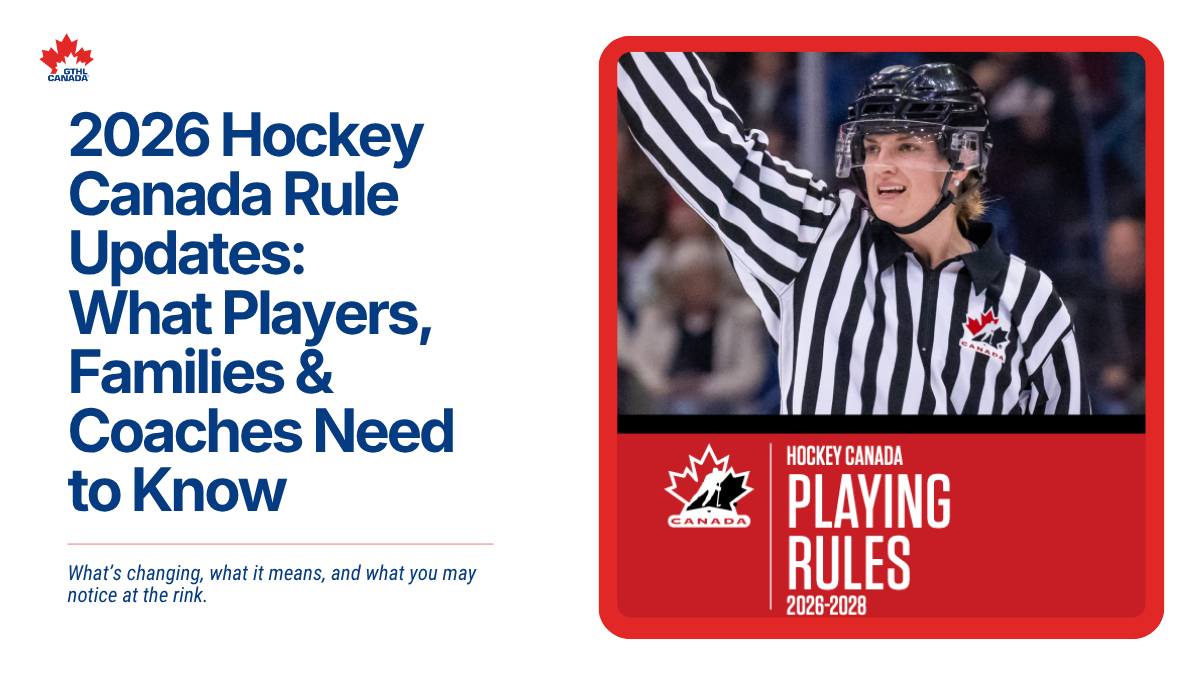
A simplified look at what’s changing, what it means, and what you may notice at the rink this season
With the puck about to drop on the 2026–27 season, Hockey Canada has introduced a number of updates to its Playing Rules.
While some changes are primarily technical in nature for officials, understanding the basics can help players, coaches, and families know what to expect when they get to the rink — and better understand the calls being made on the ice.
The GTHL has put together a simplified guide highlighting some of the key updates across three main areas: penalty situations, game flow and stoppages, and player and goaltender safety.
CLICK HERE — 2026 Hockey Canada Rule Updates: What Players, Families & Coaches Need to Know
Penalty situations
There are several changes and clarifications related to penalties and how officials manage them.
One of the most significant involves what happens when a goal is scored while a team is shorthanded — or about to become shorthanded because of a delayed Minor or Bench Minor penalty. In certain situations, the penalty with the least amount of time remaining will now terminate.
There are also updated referee mechanics for tripping and slew-footing signals, as well as new terminology for deferred penalties.
Game flow and stoppages
A number of updates may also change what players and coaches notice during stoppages in play.
In U18 AAA, if the defending team accidentally dislodges its net and causes a stoppage, that team will not be permitted to make a line change. Officials will also use an updated signal when calling icing, raising their non-whistle arm after stopping play.
The criteria for determining a goal involving a possible high stick has also been clarified. For an attacking player, the important measurement is the point where the puck contacts the stick relative to the crossbar.
There are also updated procedures when a team refuses to start or resume play.
Additional protection for goaltenders
Player safety remains an important part of the updated rules.
In U13 and below, play will now be stopped as soon as it is safe to do so when a goaltender is struck in the head by the puck, unless the puck deflects directly into the net. For the purpose of this rule, head contact refers specifically to the goaltender’s mask or helmet and does not include a throat protector attached to the mask.
Coaches also have an additional option when a goaltender goes to the Players’ Bench during a stoppage: where permitted, the team may now use its time-out.
Want to learn more?
GTHL officials have been preparing for the updated rules ahead of the 2026–27 season. Shane Steenhoek also walks GTHL officials through the key changes and what they need to know and apply this season.
CLICK HERE — 2026 Hockey Canada Rule Updates Video
For additional resources, visit the GTHL Learning Centre — created with officials in mind, but filled with helpful information for anyone looking to better understand the game.