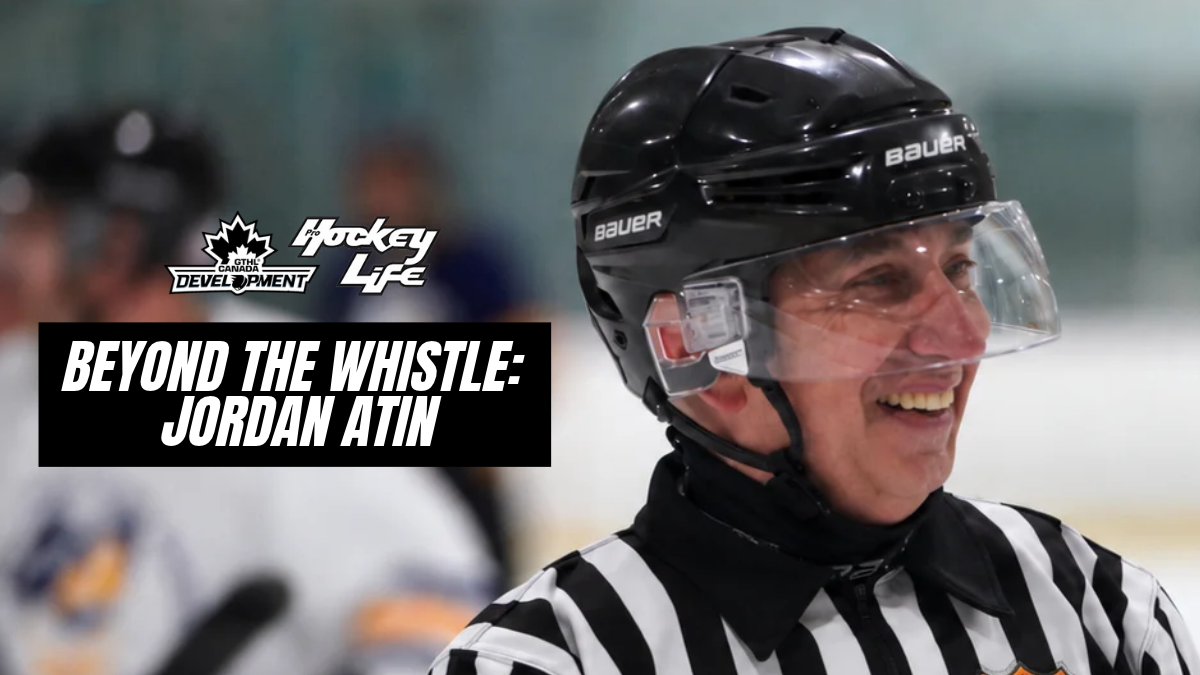
For most people, a part-time job at age 15 becomes little more than a distant memory. A summer position, a weekend shift, a way to save for post-secondary or a car. For Jordan Atin, that teenage job never really ended. Forty-five seasons later, he is still lacing up his skates to keep games fair and safe as a GTHL official.
At 59 years old, Atin has spent nearly his entire life around hockey. He first entered the sport as a young goalie with the Forest Hill Hockey Association. After trying higher levels of competition, he returned to house league hockey and enjoyed the game at its purest level. When he was 15, he began officiating local games.

Today, Atin stands as one of the most experienced officials in the Greater Toronto Hockey League, having worked in the league since 2011 while accumulating more than four decades officiating experience overall. Yet what stands out most about his story is not longevity alone. It’s the enthusiasm he still brings to every assignment.
“The challenge, both physically and mentally, is what I like,” Atin explained. “I love still being part of the game.”
While coaches, trainers, and spectators all contribute to the hockey experience, Atin believes officials occupy a unique place. They are among the few people who share the ice with the players themselves. From his eyes, officials form the “third team” in every game, responsible not only for enforcing the rules but also for helping create a fair and safe environment for competition.
The role continues to challenge him, even after 45 seasons.
Many would assume that someone with Atin’s resume has mastered every aspect of officiating, but he sees it differently. Every season brings new lessons, new corrections, and new opportunities to improve. He maintains personal checklists of habits and techniques he wants to focus on and regularly reflects on previous performances.
“Even after 44 years, there are tons of things that I am discovering and learning from,” he said. “There’s always something to improve.”
That mindset is especially notable considering how dramatically officiating has evolved throughout his career. Overall development for positioning, skating routes, and game management are taught with a much greater level of structure and detail. Atin has embraced the growth of officiating as a opportunities to improve alongside it.
Part of that growth comes from a commitment to staying physically prepared. Cycling in spring and summer is a great way he’s maintained conditioning so he can continue keeping pace with increasingly skilled and faster players. As someone who originally became a goalie partly because he struggled with skating, continuing to work on that area remains a point of pride.
“The skating was the hardest part for me,” he recalled of his early officiating days. “And today, it’s still a challenge. I still work on my skating.”
Atin describes himself as a specialist by nature. While referees manage penalties and broader game control, Atin enjoys concentrating on offsides, icings, and the other responsibilities that come with patrolling the lines. The role suits both his personality and his approach to problem-solving.
“I like to be a specialist,” he said. “I like to do one job.”
That same philosophy extends beyond the rink. Professionally, Atin is an estate law specialist and teaches at Osgoode Hall Law School. In both hockey and law, he values expertise, preparation, and deep knowledge. While he encourages young people to build broad foundations before specializing, he understands his own strengths and where he is most effective.
Atin sees parallels between officiating and law. In both fields, written rules provide guidance, but real life rarely fits perfectly inside neat categories. Judgment, interpretation, and preparation are essential.
The difference, he notes with a smile, is that lawyers often have time to reflect before making decisions. Officials rarely enjoy that luxury.
Throughout his career, Atin has benefited from the guidance of mentors who helped shape his development. Early influences in the North York Hockey League included officials such as Steve Gerry, Norm Belyea, Seth Kirshenbaum, and former NHL official Dean Warren. Their mentorship helped transform a young official learning through trial and error into someone capable of performing at the highest levels of minor hockey.
Today, Atin tries to pass that same support on to younger officials.
One of the greatest rewards of officiating, he says, is working alongside teenagers and young adults who are just beginning their own journeys. Whether the conversation involves hockey, school, careers, or life in general, he enjoys being part of their growth.
“It keeps me young to hear what’s going on in their lives,” he said.
He speaks warmly about the camaraderie that develops among officials and the satisfaction that comes from being part of a crew where everyone supports one another.
His goal every time he arrives at the rink is simple: bring positive energy.
“My skills are limited,” he joked, “but my attitude is not.”
That attitude has helped earn the respect of colleagues, supervisors, and coaches throughout the hockey community. Atin hopes that when fellow officials see his name on an assignment sheet, they are happy to know they will be working together.
Among his many accomplishments, few stand out more than being selected to officiate the OHL Cup. Atin has worked the tournament multiple times, an achievement he describes as one of the highlights of his officiating career.
Atin often reflects on the opportunity to work alongside elite officials whose careers progressed to the highest levels of hockey. He recalls sharing the ice with NHL linesperson Shandor Alphonso and speaks proudly of younger officials he has watched advance through the ranks.
His journey serves as a reminder that officiating offers opportunities for growth and achievement regardless of an individual’s playing resume. Dedication, professionalism, and a willingness to learn can take officials far.
As Atin looks ahead, he has no specific milestone circled on the calendar. Reaching 50 seasons would certainly be impressive, but numbers are not what motivate him.
As long as he enjoys the experience, remains physically capable, and continues contributing positively to the league, he intends to keep going.
More importantly, he hopes the next generation discovers the same opportunities that have enriched his own life.
For younger individuals, he describes officiating as the best part-time job one can have. It provides income, exercise, responsibility, and a chance to remain involved in the sport. Beyond hockey-specific skills, officials learn valuable life lessons about communication, teamwork, leadership, and handling conflict.
“You’re going to disappoint 50 per cent of the participants almost every time you blow the whistle,” Atin said. “You’ve got to learn how to deal with disappointment.”
Those lessons have stayed with him for decades, both on and off the ice.
For Atin, the journey has been extraordinary. If his passion is any indication, the final chapter has yet to be written. For now, the whistle is still around his fingers, the skates are still tied, and he remains right in the middle of the game.